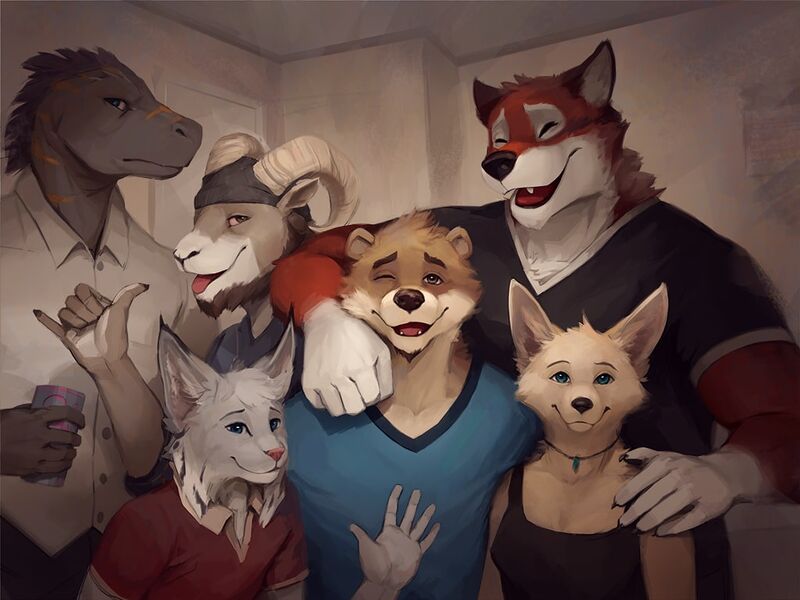
That we don't even care, to shake these zipper blues
And we don't know, just where our bones will Rest, to dust I guess; forgotten and absorbed 'To the earth, below
– 1979
ECHO has been perhaps the single hardest analysis I have had to write due to the sheer breadth of material to cover. In writing about Echo you must address the furry virtual novel medium – the endless cycles, tropes, and blemishes; in writing about Echo you must address the furry fandom – the people and the play; in writing about Echo you must address the romanticization of bildungsroman – long-gone nights trapped in some amber realm, never to be retrieved. Individually, these topics are wide and overarching, deserving of arduous analysis. To put these things together, then, would equate to either madness or a masterpiece. Safe to say, Echo falls under the latter.
There are many things I would call Echo. Echo is post-apocalyptic; Echo is an anti-Bildungsroman, an inversion of the coming-to-age story; and, strangest of all, I would call Echo anti-furry. Echo is both a bottled sentiment and the bottle. Echo is both the product of an estranged community and the estranger. At first glance, these are all strange, egregious claims. Yet these are only fitting, given Echo’s strange egregiousness itself, and how Echo stands mostly in opposition to what it is.
Where other novels show college-move ins and branching dialogue paths Echo shows the existentially horrifying dread of the return to form. Where other novels have protagonists with stars in their eyes Echo has protagonists running breathless away from their pass, barely outpacing oblivion. Where other novels show trite love, resolved by romantic dialects and trauma bounding, Echo shows the bitter truth of these venomous brittle links, only ever formed under the whims of teenage yearning and spontaneity. In this way Echo is a chiaroscuro masterpiece, painted by the taint of what it so desperately warns of.
At the heart of Echo’s contradiction, and of all of these titles, is fantasy. Fantasy, the beating bleeding-heart of the furry fandom, virtual novels, and the Bildungsroman. This realization of Fantasy’s guiding force after reading Echo was so strong that it bordered on existential. Before I explain the total tip of Echo’s spear, though, I want to address the individual factors which power its thrust. Listed below are the individual articles of which I address Echo.
1: FlYNN'S ROUTE: THE HERMIT, THE FANDOM, AND ELECTRIC SHEEP
2: LEO'S ROUTE: THE LOVERS, THE DANCE, AND WHY ARE WE THESE ANIMALS?
3: ECHO: THE WORLD, THE PEOPLE, AND FANTASIA DELENDA EST